Collection: Hand Painted Simhamukha Thangka Paintings (Lion-Faced Dakini)
Simhamukha, the Lion-faced Dakini, turns anger into awakened awareness. She is one of the most powerful wrathful figures in Tibetan art, and our artists in Boudha, Kathmandu paint her by hand, with fine detail and 24K gold, and a monk blesses each thangka before it ships. This is a small collection of two paintings, from $166 for a classic piece to $340 for a version with 24K gold, and we paint to order in other sizes. Not sure if a wrathful deity suits your space? Message us and we’ll help you choose. New to the dakinis? Start with our guide to the Dakinis and female embodiments of wisdom, or see all our Dakini and Yogini thangkas.
-
Traditional Simhamukha Thangka with 24K Gold from Nepal
Regular price $340.00 USDRegular priceSale price $340.00 USD -
Simhamukha Thangka | Wrathful Lion-Faced Dakini Art
Regular price $166.00 USDRegular priceSale price $166.00 USD
Why the lion’s face?
The lion is the king of beasts, and in Buddhist symbolism the lion’s roar is the voice of the Dharma that frightens away ignorance. Simhamukha’s lion face shows her fierce, protective nature. She is a wrathful dakini, but her wrath is not anger at people. It is compassion in a forceful form, directed at the delusion and negativity that cause suffering. In the tradition she is a protector and a meditation deity who transforms anger into pristine wisdom.
What to look for in the painting
- The lion face: the sign of her fierce, protective power.
- The glaring red triple eye: it stands for insight and heightened awareness.
- A standing or dancing pose: shown in motion, surrounded by flames.
- Her implements and ornaments: a wrathful dakini is traditionally painted with a skull cup, a curved knife and skull ornaments, which stand for cutting through delusion and transcending ego. Details vary between paintings.
- Flames and a dark, intense palette, the fire of wisdom that burns away negativity.
In the tradition she is invoked for courage, purification, and protection from negative influences. In the language of practice, those are meant as inner protections: against anger, fear and obstacles in the mind. A thangka of Simhamukha is a meditation support, not a guarantee of any outcome.
Is a wrathful deity right for your space?
Many buyers ask this, and it is a fair question.
- Wrathful does not mean unwelcoming. In Tibetan homes and temples, wrathful protectors often stand guard at an entrance or in a shrine room, because they are there to protect.
- Choose it if you want a bold, striking piece, you are drawn to protector deities, or you practice and want a proper image of Simhamukha.
- Think about placement. A bedroom or a space where you want calm may suit a peaceful deity better. A shrine room, a study, a meditation space or an entrance wall suits a protector.
- Prefer something gentler? Compare our Kurukulla thangkas or our Vajrayogini thangkas, or see the wider family of wrathful protectors.
Send us a photo of your space and tell us what you have in mind, and we’ll tell you honestly whether this is the right deity.
The two paintings in this collection
- The traditional Simhamukha thangka with 24K gold ($340): our fuller, more detailed painting, with real 24K gold work that catches the light. Choose it as a centerpiece or a collector’s piece.
- The Simhamukha thangka, a wrathful lion-faced dakini ($166): a classic painting at an accessible price, well suited to a personal altar or a smaller wall.
Prices differ with size, the amount of gold work and the detail in the painting. If you want a different size, or a particular form of Simhamukha, we paint to order through our commission page. For general advice, read how to choose the right Buddhist thangka, or try our Pick Your Thangka guide.
A note on practice and respect
Simhamukha practice belongs to Vajrayana tantra, which is traditionally received from a qualified teacher. You do not need to practice to display a Simhamukha thangka as sacred art, and many people keep one out of respect for the tradition. If you practice, ask your teacher how to place and care for the image. We are glad to answer questions about the iconography.
Why buy a Simhamukha thangka from Buddha’s Art of Healing
- Painted by hand, never printed, on canvas with mineral pigments and 24K gold. Meet our artists, or see how a thangka is made.
- Blessed by a monk before it leaves our gallery.
- Made at the source, at our gallery by Boudhanath Stupa in Kathmandu, and operating since 1976. Read our story.
- Made your way. Ask for a custom size or a silk brocade mount.
- Shipped worldwide with tracking and insurance, rolled and wrapped in protective silk. See our shipping policy.
- Easy to verify. Our guide to authentic vs replica thangkas shows how to tell an original from a print.
Displaying your thangka
Hang it at or above eye level on a clean, quiet wall or altar, never on the floor, and away from bright sunlight and humidity. Our Buddhist altar setup guide shows how to arrange the space. A silk brocade mount gives the traditional border, and why brocade matters in a thangka explains the tradition.
Explore more dakini and deity thangkas
Browse all of our Dakini and Yogini thangkas, including Vajrayogini and Kurukulla. For other deities, see our Buddhism deities thangkas and Guru Rinpoche thangkas.
FAQs for Hand Painted Simhamukha Thangka Paintings (Lion-Faced Dakini)
Who is Simhamukha?
Simhamukha, the Lion-faced Dakini, is a wrathful dakini of Vajrayana Buddhism. She stands for the transformation of anger into awakened awareness and is a protector and meditation deity.
What does Simhamukha represent in Buddhist practice?
She represents the subjugation of negativity and the transformation of anger into pristine wisdom.
How can her thangka help my practice?
It serves as a meditation support for courage, purification and protection against inner obstacles. It supports practice and does not replace a teacher’s guidance.
What does the lion face mean?
The lion’s roar stands for the voice of the Dharma, which drives away ignorance. Her lion face shows her fierce, protective nature.
Is it suitable for a home?
Yes. Many people keep wrathful protectors in a shrine room, study, meditation space or near an entrance. If you want a calm bedroom, you may prefer a peaceful deity.
Do I need an empowerment to own a Simhamukha thangka?
No. You can display a thangka as sacred art without practicing. The practice itself is traditionally received from a qualified teacher.
What materials are used?
Our Simhamukha thangkas are hand painted on canvas with mineral pigments and 24K gold.
Are they hand painted and blessed?
Yes. Our artists hand paint every thangka in the traditional way, and a monk blesses each one before it ships.
Can I order a custom Simhamukha thangka?
Yes. Tell us the size and mounting you want through our commission page, and we will paint it for you.
Will it arrive safely, and what if there is a problem?
We roll the thangka carefully, wrap it in protective silk, and ship it worldwide with tracking and insurance. If something goes wrong, read our refund policy and contact us, and we will help.
Ready to bring Simhamukha home?
Choose your thangka above, or tell us the size and mounting you want through our commission page and we’ll paint it for you. Questions first? Message us on WhatsApp.
Explore Other Thangka Categories
-
Buddha Thangka Paintings Collection
Explore our collection of Buddha Thangka paintings, featuring traditional Tibetan Buddhist artwork...
-
Hand Painted Bodhisattva Thangkas and Paintings
A bodhisattva is an enlightened being who stays in the world to...
-
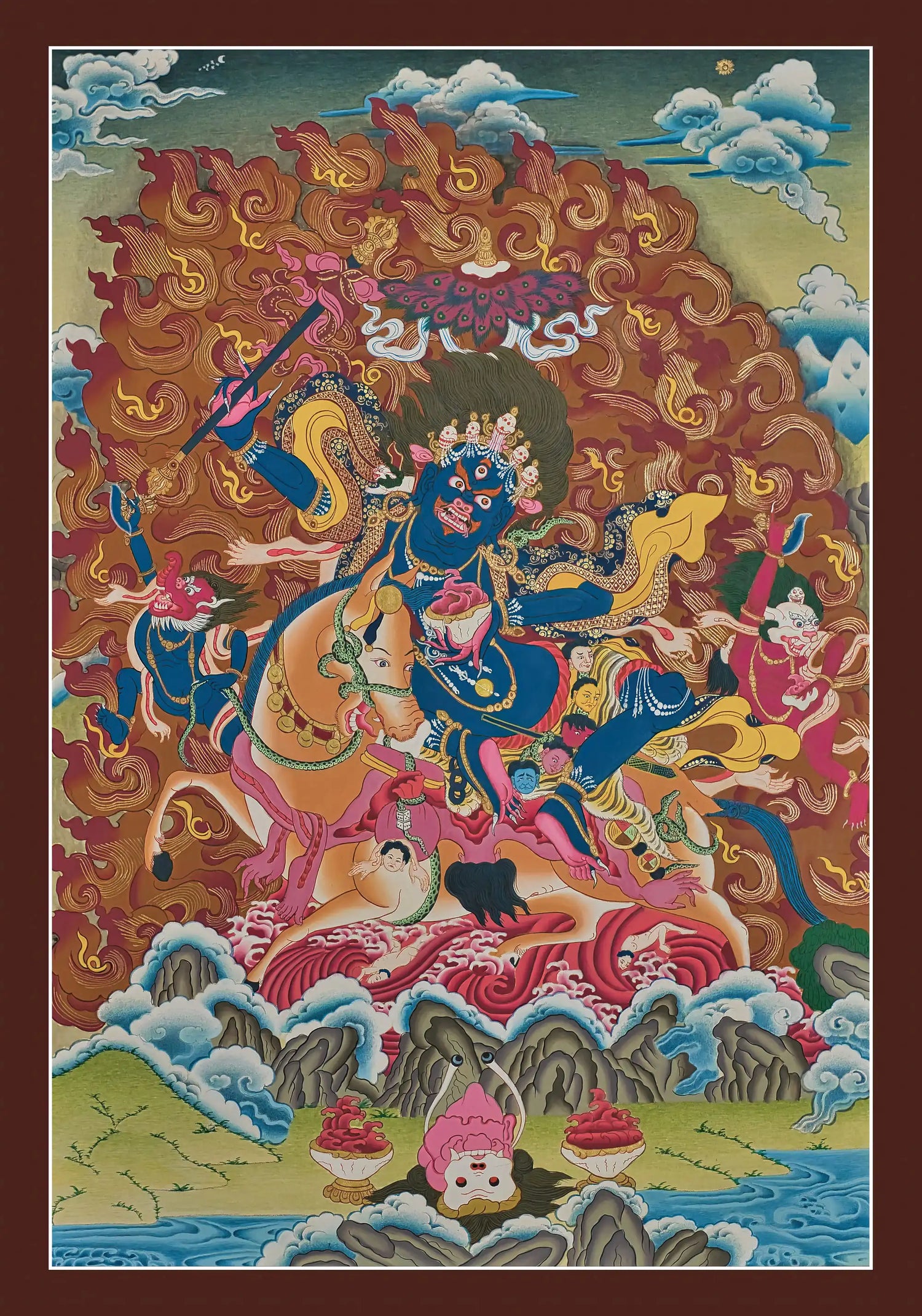
Hand Painted Buddhist Deity Thangkas
Every Buddhist deity stands for something you can feel in your own...
-
Guru Rinpoche Thangkas: Hand-Painted Padmasambhava Paintings from Nepal
uru Rinpoche, also known as Padmasambhava, is the master who carried Vajrayana...
-
Exclusive Thangkas Collection
-
Hand Painted Dakini and Yogini Thangka Paintings
Dakini and Yogini thangkas are some of the most striking paintings in...