What “conquering death” really means
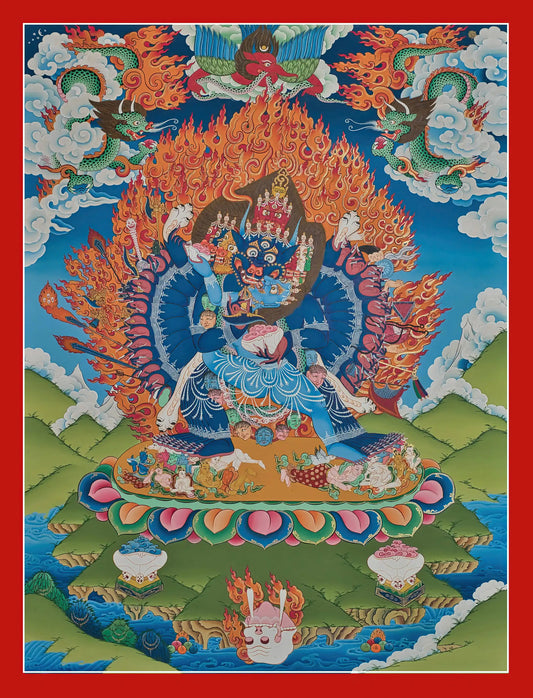
The name sounds dramatic, so it is worth explaining. Yamantaka does not promise that anyone avoids physical death. In Buddhist teaching, “Yama”, the Lord of Death, stands for the whole cycle of birth and death that ignorance keeps turning, and for the fear of it. Yamantaka conquers that cycle by wisdom. The buffalo-headed form is Vajrabhairava, “Vajra Terrifier”, a fierce form of Manjushri whose wrath is compassion directed at ignorance, ego and fear, never at people.
That is why a Yamantaka thangka is about courage and clarity. It supports reflection on impermanence and the cutting of delusion, and it is a meditation support, not a guarantee of any outcome.
How to read a Yamantaka thangka
Every part of the painting carries a meaning:
- The buffalo head: the central, fierce face, the form that overcomes Yama. At the top of the head, Manjushri’s peaceful face is often shown above the wrathful ones, a reminder that the fierce form comes from wisdom and compassion.
- Many heads, arms and legs: in the full form of Vajrabhairava he has nine heads, thirty-four arms and sixteen legs. Each hand holds a symbolic implement, and each head and limb stands for a quality of awakened activity.
- Blazing wisdom fire: the flames around him burn away delusion.
- Standing over subdued figures: these stand for the ego, ignorance and obstacles he has overcome.
- Skull crown, bone ornaments and sacred garments: they stand for impermanence and fearlessness.
Details vary between lineages and between paintings, so our artists follow the iconography of the tradition each thangka belongs to. If your practice follows a specific form, tell us before you order.
Is Yamantaka the right deity for you?
- Choose Yamantaka if you practice, or plan to, and want a proper image for your shrine; if you are drawn to Manjushri’s wisdom in a fierce form; or if you collect powerful, detailed Tibetan art.
- Think about placement. A wrathful deity suits a shrine room, a study, a meditation space or an entrance wall better than a bedroom you want to feel calm.
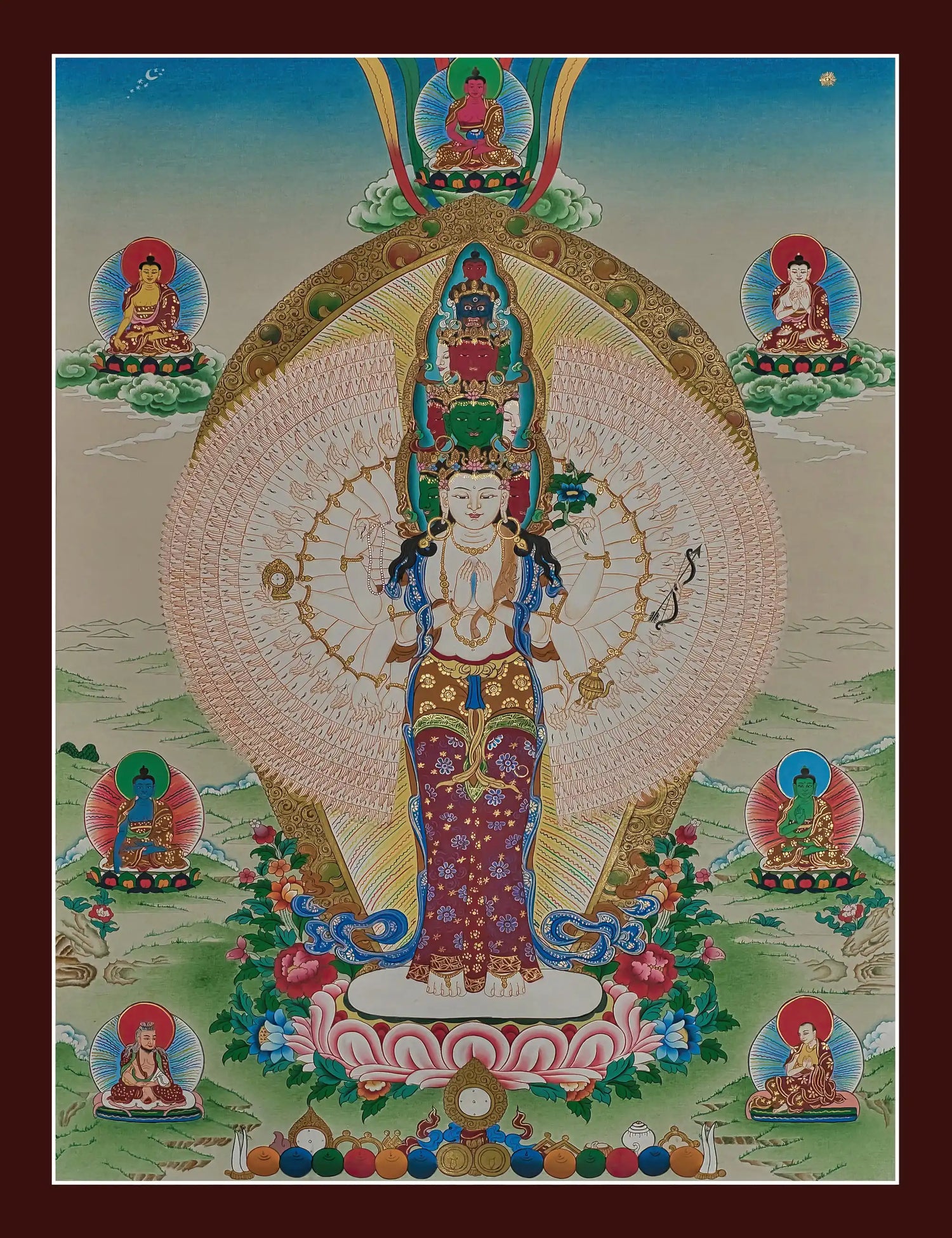
- Prefer the peaceful side? See our Bodhisattva thangkas for Manjushri and others, or compare another protector in our Buddhist deity thangkas.
Send us a photo of your space and tell us what you have in mind, and we’ll say honestly whether this is the right deity.
Choosing among our Yamantaka thangkas
This is a small collection with a wide price range, so here is how to think about it:
- Smaller pieces, from $175: suited to a personal altar, a shelf or a first Yamantaka.
- Mid-priced pieces, around $310: more presence on a wall.
- Large 18" x 24" paintings, around $1,000 to $1,060: our most substantial Yamantaka thangkas, for a shrine room wall, a practice space or a serious collection, where the fine detail in the many heads, arms and flames can be seen properly.
Prices depend on size, the amount of gold work and the detail in the painting. For a figure with this many parts, that detail takes our artists a long time. If you want a different size or a specific form, we paint to order through our commission page. For general advice, read how to choose the right Buddhist thangka, or try our Pick Your Thangka guide.
A note on practice and respect
Yamantaka practice belongs to Vajrayana tantra, which is traditionally received from a qualified teacher through empowerment. You do not need to practice to display a Yamantaka thangka as sacred art, and many people keep one out of respect for the tradition. If you practice, ask your teacher how to place and care for the image. We are glad to answer questions about the iconography.
Buy with confidence
- Painted by hand, never printed, following traditional Tibetan practice. Meet our artists, or see how a thangka is made.
- Blessed by a monk before it leaves our gallery.
- Made at the source, at our gallery by Boudhanath Stupa in Kathmandu, and operating since 1976. Read our story.
- Mounted your way. Choose traditional silk brocade mounting to suit your decor or altar. Why brocade matters in a thangka explains the tradition.
- Shipped worldwide with tracking, secure packaging and customs documentation. See our shipping policy.
- Easy to verify. Our guide to authentic vs replica thangkas shows how to tell an original from a print.
- Talk to us first. For a piece at this level, we’re happy to answer questions on WhatsApp before you buy.
Displaying your thangka
Hang it at or above eye level on a clean, quiet wall or altar, never on the floor, and away from bright sunlight and humidity. Our Buddhist altar setup guide shows how to arrange the space.
Explore more deity thangkas
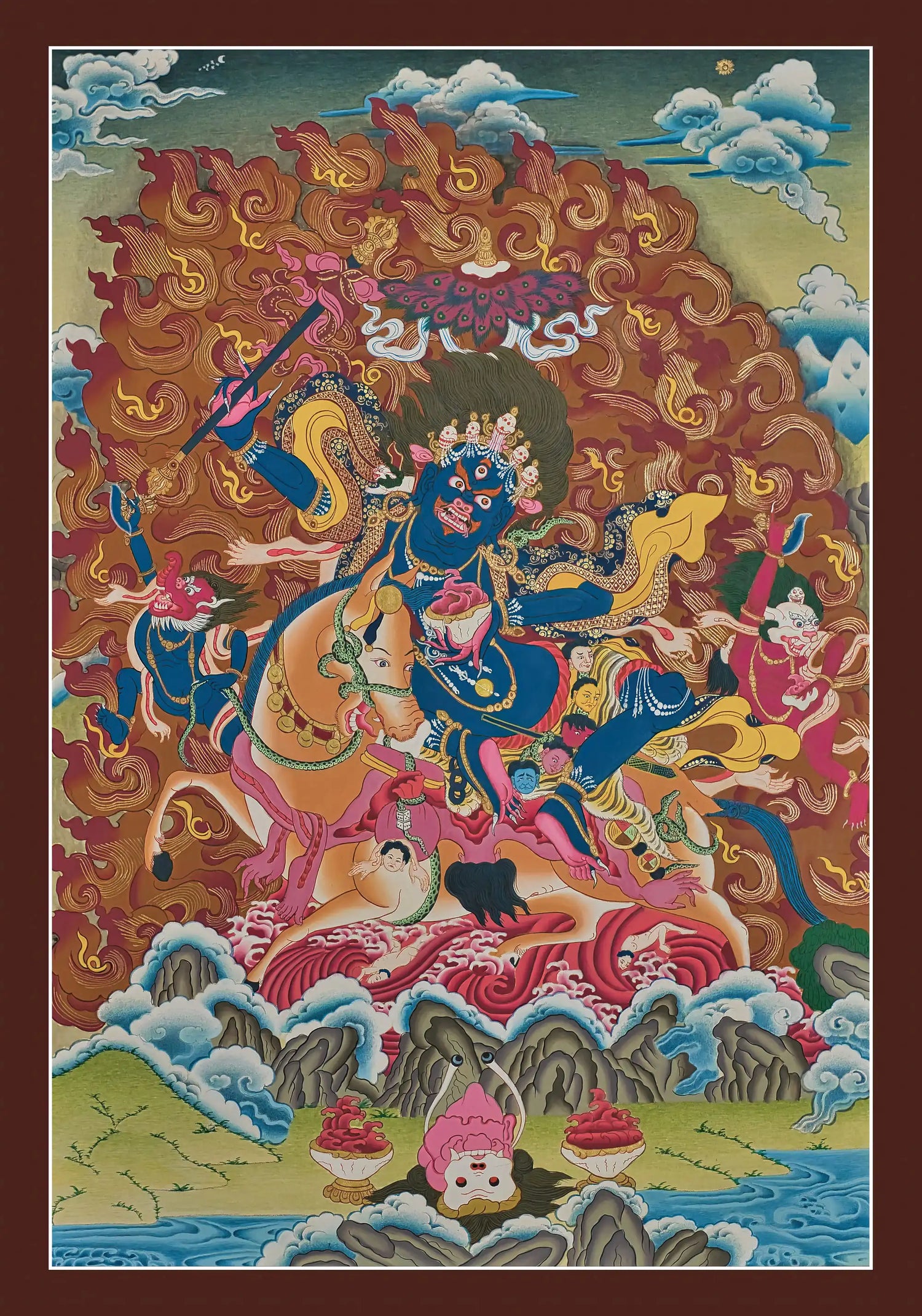
Yamantaka is the wrathful form of Manjushri, so you may also like our Bodhisattva thangkas and our guide to the Bodhisattvas in Buddhism. For the wider family of protectors, see our Mahakala thangkas and all our Buddhist deity thangkas.